Pallet Dimensions Reference: GMA, Euro, ISO, and Specialty Sizes
If you have ever stood in a warehouse trying to remember whether the pallet in front of you is a 48 by 40 or a 42 by 42, or scrambled to confirm a Euro pallet's footprint before a container booking, this page is built to be the one you bookmark. Pallet dimensions sound like a settled, simple topic until you are the person responsible for making freight fit, racking line up, and product arrive undamaged. Then the specifics matter, and getting them wrong gets expensive.
This is a reference, not a lecture. Below you will find the dimensions, load ratings, and best-fit applications for every major pallet standard in North American and international shipping, plus the specialty sizes that show up when standard simply does not work. We have also packaged the whole thing into a one-page spec chart you can download, print, and pin up wherever pallet decisions get made.
At Hallwood, we have spent 45+ years supplying every size on this chart, standard, international, and fully custom, through a network of 75+ mill partners across 30+ states. So consider this both a quick-reference tool and a straight answer to the question behind it: whatever size your operation needs, it can be sourced, graded, and delivered reliably.
The North American Standard: the GMA 48" x 40" Pallet
If there is one pallet to know, it is this one. The 48-inch by 40-inch pallet established by the Grocery Manufacturers Association (GMA) is the dominant standard across North America, and most supply chains are built around it. The dimensions were engineered to maximize space inside standard trailers, containers, and racking: the 40-inch width lets two pallets sit side by side in a 96-inch-wide trailer with minimal wasted space, while the 48-inch length aligns with standard rack depths.
A standard GMA pallet typically supports about 2,500 pounds of dynamic load (in motion on a forklift or pallet jack) and up to roughly 4,500 pounds of static load (at rest in storage). If your products move through mainstream retail, grocery, or general merchandise channels, you are almost certainly on GMA pallets, and the payoff is compatibility with the established infrastructure of nearly every shipper and receiver on the continent.
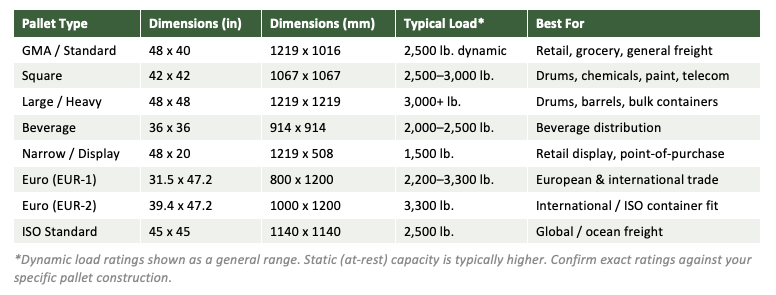
The Full Size Comparison Chart
Here is the at-a-glance comparison of the pallet sizes you are most likely to encounter, with both imperial and metric dimensions, typical load ratings, and the applications each size serves best. Load ratings are general industry ranges; exact capacity depends on construction, wood species, and deck configuration.
Euro, ISO, and International Sizes: When You Ship Across Borders
The moment your freight crosses into European distribution or onto an ocean vessel, the GMA standard stops being the default. Euro pallets, governed by the European Pallet Association, measure 800mm by 1200mm (about 31.5 by 47.2 inches) for the common EUR-1 footprint, and they are engineered around European truck and racking dimensions the same way GMA is engineered around North American ones.
ISO pallet standards recognize six footprints used around the world, including the 1140mm by 1140mm size common in Australian and Asian trade and the 1067mm by 1067mm (42 by 42 inch) size that doubles as a North American square pallet. If you containerize for export, the question is not which pallet you prefer; it is which footprint loads most efficiently into the specific container and market you are shipping to. Many manufacturers maintain the ability to ship both GMA and Euro/ISO sizes so they can serve domestic and international channels without disruption.
Specialty and Custom Sizes: When Standard Does Not Fit
Standard pallets serve the vast majority of freight efficiently, but a meaningful share of shipments do not cooperate. Oversized machinery, irregular or fragile products, unusual weight distribution, or strict export container math can all push you past what a stock size can do well. Forcing an awkward product onto a standard pallet where it overhangs, shifts, or concentrates weight is how product damage and safety incidents start.
That is where custom engineering earns its place. A pallet built to the exact footprint, deck-board spacing, and reinforcement pattern your product needs maximizes stability and protection while still optimizing transportation efficiency. Custom does not have to mean expensive; it means specified for the job. Hallwood's engineering team designs hundreds of custom specifications a year, and the 75-mill network means those orders get sourced and produced without the long lead times a single-facility supplier would impose.
How to Choose the Right Size: A Quick Decision Guide
Walk these five questions in order and the right specification usually becomes obvious:
Product footprint and weight. What is the loaded size and weight, and does your case or container size pack cleanly onto a given pallet without wasted space or overhang?
Truck and container fit. How many pallets fit your standard trailer or ocean container? Maximizing fill rate is where freight savings live.
Existing racking. Your racks are engineered for specific dimensions. A size that overhangs or exceeds rated capacity is a safety problem, not just an inconvenience.
Stacking and storage. How many tiers can you safely stack? That drives floor-space requirements and total cost of ownership.
One-way or returnable. One-way pallets can use lighter construction; returnable pallets need to survive many cycles. The right build differs for each.
Not sure which size fits your freight?
The right pallet is not a guess; it is engineered to match your product, your racking, and your routes. If you want a second set of eyes on your specification, Hallwood's team has spent more than 45 years sizing pallets for operations of every scale across 30+ states.
Contact Hallwood today to talk through your pallet sizing, or request a quote. Prefer to talk now? Call us at (757) 357-3113.