5 Ways Sustainable Pallets Reduce Your Company's Carbon Footprint
Corporate sustainability has moved from the margins of business strategy to the center of procurement decision-making. If you are a supply chain leader, operations director, or sustainability officer, you already know that your stakeholders, customers, investors, regulators, and your own employees are paying closer attention than ever to the environmental impact of your operations. And while conversations about sustainability often focus on energy consumption, fleet emissions, or manufacturing processes, one of the most impactful and most overlooked sustainability opportunities in any supply chain sits right on your loading dock: the wood pallet.
Wood pallets are the backbone of global logistics. An estimated two billion pallets are in circulation in the United States alone, and the choices companies make about their pallet programs have real, measurable consequences for carbon emissions, resource consumption, and waste generation. The good news is that wood pallets, when sourced and managed responsibly, are one of the most sustainable packaging solutions available, and companies that partner with the right pallet supplier can turn their pallet program into a genuine competitive advantage in sustainability reporting and corporate environmental commitments.
At Hallwood Enterprises, sustainability is not a marketing talking point. It is embedded in how we operate, from our sourcing practices and recycling programs to our active conservation efforts. Here are five concrete ways that sustainable pallet practices reduce your company's carbon footprint, and how Hallwood helps you realize those benefits.
1. Wood Is a Renewable, Carbon-Sequestering Resource
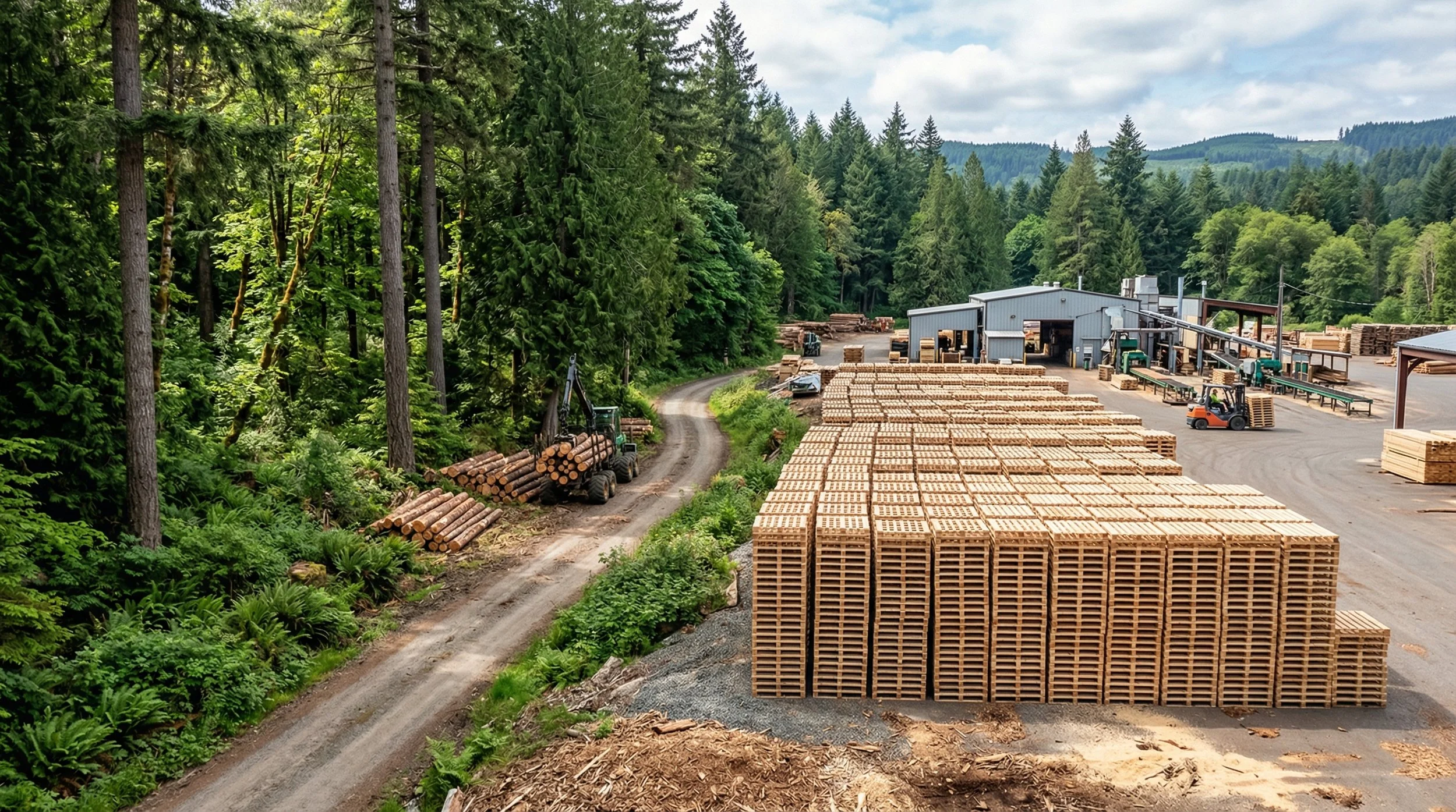
The most fundamental sustainability advantage of wood pallets begins long before a single board is cut. It starts in the forest.
Wood is the only major structural packaging material that is genuinely renewable. Trees grow, they are harvested, new trees are planted, and the cycle repeats. Compare this to plastic pallets, which are manufactured from petroleum, a finite, non-renewable fossil fuel, or metal pallets, which require energy-intensive mining and smelting operations. The raw material lifecycle of wood pallets is inherently more sustainable than any alternative.
But the story goes deeper than simple renewability. Trees actively remove carbon dioxide from the atmosphere as they grow, converting it through photosynthesis into the carbon-based cellulose that forms wood fiber. A single mature tree can absorb approximately 48 pounds of carbon dioxide per year, and the carbon remains stored in the wood even after the tree is harvested and converted into lumber. When that lumber becomes a pallet, the carbon stays locked in the wood for the duration of the pallet's useful life, which, in a well-managed program, can span ten to fifteen years or more across multiple use cycles.
This carbon sequestration effect means that wood pallets are not just carbon-neutral — they are, in a meaningful sense, carbon-negative during their useful life. The carbon dioxide absorbed during tree growth is stored in the pallet rather than being released back into the atmosphere. According to the National Wooden Pallet and Container Association, wood pallets store approximately 75 percent of the carbon absorbed during the growth of the source timber, making them one of the few industrial products that actively contribute to atmospheric carbon reduction.
The sustainability of wood as a raw material depends, of course, on responsible forestry practices. The days of clear-cutting old-growth forests for pallet lumber are long gone. Today's commercial forestry operations in North America are governed by rigorous federal and state regulations, third-party certification programs like the Sustainable Forestry Initiative and the Forest Stewardship Council, and market-driven sustainability standards that require replanting, selective harvesting, and ecosystem management. The forests supplying lumber for American pallet production are managed as renewable crops harvested on sustainable rotations and replanted to ensure continuous growth.
Hallwood's network of 75+ mill partners sources exclusively from responsibly managed forests that comply with applicable sustainability standards. When you purchase pallets from Hallwood, you can be confident that the wood in those pallets came from forests that are being actively managed for long-term sustainability, not depleted for short-term gain.
2. Reuse Extends the Lifecycle and Multiplies the Environmental Benefit
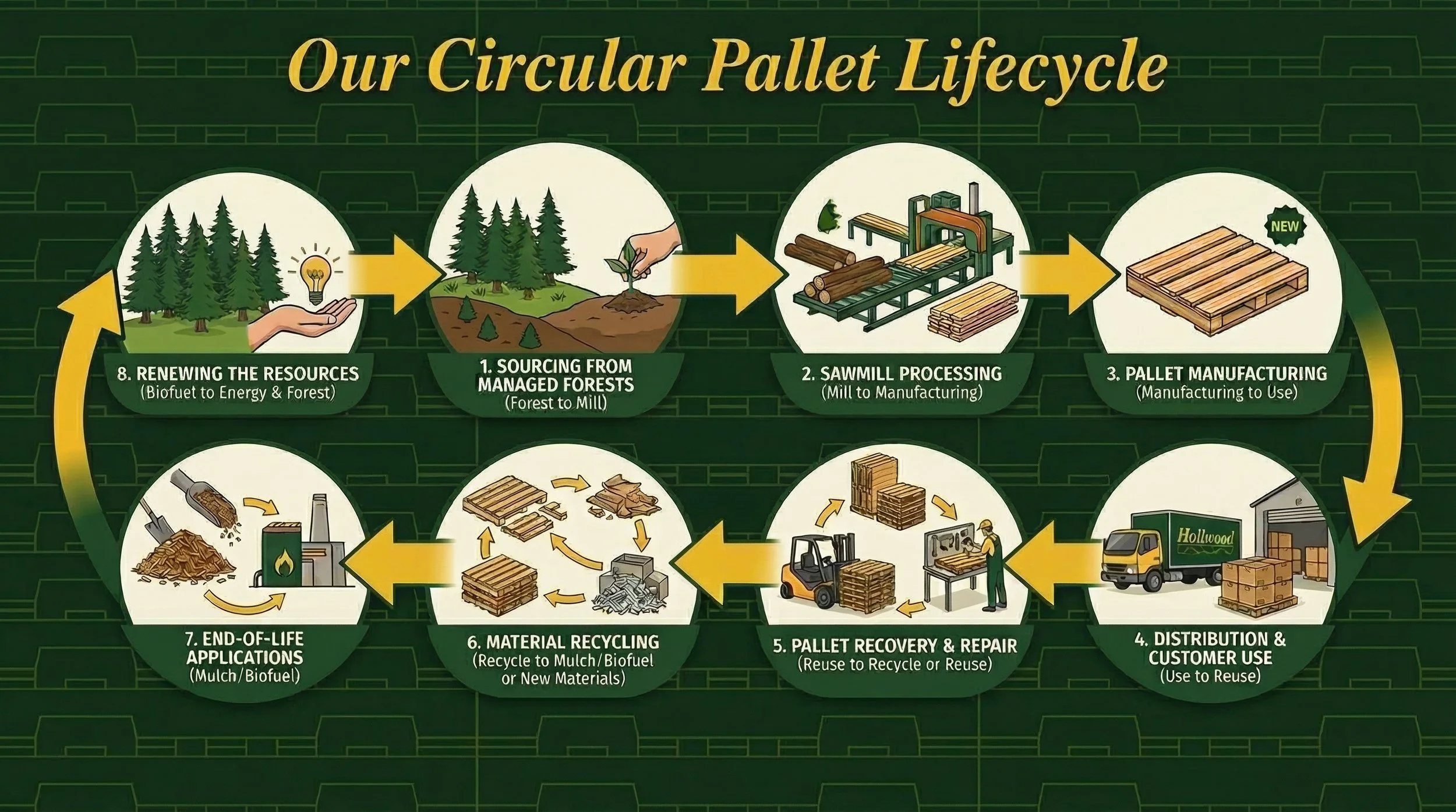
If a wood pallet were used once and discarded, its environmental advantage would be modest. But pallets are not single-use products. In a well-managed pallet program, each pallet is used, returned, inspected, repaired if necessary, and sent back into service multiple times. This reuse cycle is where the environmental math becomes truly compelling.
A typical quality wood pallet in Hallwood's program is reused ten to fifteen times before it reaches end-of-life. Each reuse cycle extends the useful life of the wood and avoids the environmental cost of manufacturing a new pallet. When you consider that manufacturing a new pallet requires harvesting and processing lumber, consuming energy for sawing and assembly, and generating transportation emissions for delivery, every additional use cycle represents a significant environmental saving.
The compounding effect of reuse means that the per-use environmental footprint of a well-managed pallet is a fraction of its initial manufacturing impact. A pallet used fifteen times has one-fifteenth the per-use carbon footprint of a single-use pallet. For a company shipping thousands of pallets per month, the cumulative environmental savings from a robust reuse program are substantial — measured in tons of carbon emissions avoided, thousands of board feet of lumber conserved, and significant reductions in energy consumption.
Making reuse possible requires a systematic approach to inspection and repair. At Hallwood, every returned pallet goes through a quality grading process. Pallets that are structurally sound return directly to service. Pallets with minor damage a cracked deck board, a loose nail, a chipped stringer are repaired with fresh lumber and quality fasteners, restoring them to full functionality at a fraction of the environmental and economic cost of building a new pallet. This inspect-and-repair discipline is the engine that drives the reuse cycle, and it requires the kind of operational expertise and infrastructure that Hallwood has developed over more than four decades.
The reuse model also creates a natural incentive for quality in initial construction. A pallet built with quality materials and proper engineering survives more use cycles than a cheaply built alternative, which means that the upfront investment in quality construction pays environmental dividends throughout the pallet's extended lifecycle. This is one reason why Hallwood invests in engineering support and material quality, even for standard pallet specifications. Better initial quality translates directly into more reuse cycles and better environmental outcomes.
3. End-of-Life Recycling Ensures Nothing Goes to Waste
Every pallet eventually reaches the end of its useful life. After ten, twelve, or fifteen use cycles, the accumulated wear from handling, loading, and transit renders a pallet unsuitable for further repair and reuse. In a poorly managed program, these end-of-life pallets become waste — headed for a landfill where the stored carbon eventually breaks down and returns to the atmosphere as carbon dioxide and methane.
In a well-managed program, however, end-of-life pallets enter a recycling stream that converts them into valuable secondary products, ensuring that the wood continues to serve a useful purpose and delaying or eliminating its contribution to landfill waste.
The most common secondary use for recycled pallet wood is landscape mulch. The wood is ground into chips of various sizes and grades, producing mulch that is used in residential landscaping, commercial property maintenance, and municipal beautification projects. This application keeps the wood in a useful form while allowing it to decompose gradually and return its nutrients to the soil a far better environmental outcome than landfill disposal.
Wood waste from end-of-life pallets is also converted to biofuel. Ground wood is used as a fuel source in industrial boilers and biomass energy facilities, displacing fossil fuels and reducing net carbon emissions. Because the carbon in wood was originally absorbed from the atmosphere during tree growth, burning wood waste for energy is considered largely carbon-neutral from a lifecycle perspective the carbon released during combustion is offset by the carbon absorbed during the wood's growth phase.
Animal bedding represents another significant market for recycled pallet wood. Clean, processed wood shavings from pallet recycling operations are used as bedding material in agricultural operations, equestrian facilities, and pet product manufacturing. This application provides a renewable, biodegradable bedding product that would otherwise need to be manufactured from virgin wood resources.
The key point is that in a true circular economy approach, no part of a wood pallet goes to waste. From first use through multiple reuse cycles and finally into recycling, the wood serves a productive purpose at every stage. Hallwood's recycling program is designed to capture the maximum value from every pallet at every stage of its lifecycle, and our customers benefit from both the cost savings and the environmental performance that this circular approach delivers.
4. Local and Regional Sourcing Cuts Transportation Emissions
The environmental impact of a pallet extends beyond the wood itself to include the emissions generated in transporting raw materials and finished products. Transportation, primarily diesel-powered trucking, represents a significant component of the total carbon footprint associated with pallet production and delivery. The distance between the timber source, the mill, and the end customer directly affects how much carbon is released in getting pallets to your facility.
This is where supply chain geography becomes an environmental variable, and where Hallwood's network model provides a distinctive sustainability advantage. With 75+ mill partners distributed across multiple regions of the United States, Hallwood can match customer orders to production facilities that are geographically proximate to the delivery point. A customer in the Southeast receives pallets from mills in the Southeast. A customer in the Midwest receives pallets from mills in the Midwest. This regional sourcing approach minimizes the distance that pallets travel from mill to customer, directly reducing the diesel consumption and carbon emissions associated with delivery.
Compare this to a pallet supplier with a single manufacturing facility or a small number of concentrated production sites. These suppliers must ship pallets long distances to reach customers outside their immediate area, and the freight emissions from those extended haul distances add significantly to the total environmental footprint of each pallet. A pallet that travels 800 miles from mill to customer generates roughly four times the transportation emissions of a pallet that travels 200 miles — and those emissions add up quickly across thousands of pallet deliveries per year.
Hallwood's regional sourcing model also reduces the environmental impact of raw material transportation. Mills in our network source their timber from nearby forests, minimizing the distance logs must travel for processing. This upstream logistics optimization further reduces the total carbon footprint of every pallet we produce and deliver.
For customers who operate facilities in multiple states, Hallwood's geographic breadth is particularly valuable from a sustainability perspective. Rather than shipping all pallets from a single distant source, we can coordinate production and delivery from multiple regional mills, optimizing freight routes and minimizing the total transportation carbon footprint across your entire facility network.
5. Hallwood's Active Conservation Program
Sustainability at Hallwood extends beyond operational practices to include direct investment in environmental conservation. We believe that companies in the wood products industry have a particular responsibility to give back to the forests and ecosystems that provide our raw materials, and we take that responsibility seriously.
Hallwood's conservation program includes the planting of thousands of trees annually, contributing to reforestation efforts that replenish timber stocks, restore wildlife habitat, and enhance the carbon sequestration capacity of working forests. These planting initiatives are concentrated in the communities where Hallwood operates, ensuring that the environmental benefits flow to the regions that support our supply chain.
Our partnerships with conservation organizations in Virginia and across the Southeast provide both financial support and volunteer engagement for habitat restoration, watershed protection, and sustainable forestry education. These partnerships reflect Hallwood's belief that environmental stewardship is not a cost of doing business it is a core business value that strengthens our company, our industry, and the communities we serve.
The conservation program also provides tangible value for our customers. Companies partnering with Hallwood can document their pallet supplier's conservation activities in their own ESG reports, adding a concrete, verifiable sustainability story to their corporate environmental commitments. In a world where customers, investors, and regulators are increasingly skeptical of vague sustainability claims, having a supply chain partner with documented, measurable conservation programs provides credibility that generic sustainability statements cannot.

Making It Count: Pallet Sustainability in Your ESG Reporting
Having a sustainable pallet program is only valuable if you can document and communicate its impact effectively. For companies with formal ESG reporting requirements and that group is growing every year pallet sustainability contributes to several key reporting categories.
Under Scope 3 emissions reporting, which covers indirect emissions from your value chain, transportation-related emissions from pallet delivery and the embedded carbon in pallet materials are both relevant data points. A pallet program that emphasizes regional sourcing, reuse, and recycled content generates lower Scope 3 emissions than one relying on single-use pallets shipped long distances.
Waste reduction metrics benefit directly from pallet reuse and end-of-life recycling programs. Every pallet that is reused rather than discarded avoids waste generation, and every end-of-life pallet that enters a recycling stream rather than a landfill demonstrates measurable waste diversion.
Resource consumption metrics improve when your pallet program emphasizes recycled pallets and extended reuse cycles, reducing the demand for virgin lumber and the associated forestry, transportation, and processing resources.
Hallwood provides our customers with the data they need to quantify these impacts in their sustainability reporting. From pallet reuse rates and recycled content percentages to regional sourcing documentation and conservation program metrics, we give you the numbers that make your sustainability story concrete and credible.
Take the Next Step
Sustainability in your supply chain does not require revolutionary change. It requires smart choices about the partners you work with and the programs you put in place. Your pallet program is one of the highest-impact, lowest-effort sustainability opportunities available to any company that ships physical products.
Hallwood Enterprises has built a pallet operation that delivers measurable environmental benefits at every stage — from responsibly sourced raw materials and energy-efficient manufacturing, through multiple reuse cycles and complete end-of-life recycling, to active conservation programs that give back to the forests and communities that support our industry. When you partner with Hallwood, your pallet program becomes a genuine sustainability asset rather than an environmental liability.
Contact Hallwood today to learn how a sustainable pallet partnership can strengthen your environmental performance and support your ESG commitments.